
Introducing Four Limited Edition Declaration of Independence Gold Posters
The Declaration of Independence is an iconic piece of American history, and one that’s as meaningful today as it was in 1776. It is a foundational document that represents American values as they were first established. Now, as our nation approaches its 250th birthday, Americans are seeking new ways to celebrate and showcase their patriotism. To commemorate the 250th anniversary of our nation’s founding, we are proud to introduce four new 24-karat gold posters featuring famous depictions of the Declaration of Independence and the process that brought it to life. We chose each of these depictions for specific symbolic reasons. Continue reading to discover more about each of our four Declaration of Independence posters.
Holt Declaration of Independence
Following the initial signing of the Declaration of Independence, newspapers throughout the American colonies scrambled to publish the full text of the document and spread awareness of this monumental development. John Holt became one of the first publishers to print the full text of the Declaration of Independence, sending approximately 500 copies to government officials across the newly-created State of New York.
Of the 500 broadside edition copies, only five copies are known to exist today, making the Holt Declaration of Independence one of the rarest versions. One such copy is housed in the Rare Book Division of the New York Public Library, although it is not currently on public display. Of the remaining copies, one is privately held (auctioned by Sotheby’s for $1.5 million in 2017), while the other three are housed at various libraries throughout the United States.

Binns Declaration of Independence
Responding to a renewed sense of American patriotism in the wake of the War of 1812, publisher John Binns designed and published an artistic print featuring the full scroll of the official Declaration of Independence, surrounded by a wreath-like motif featuring prominent Founding Fathers and various symbols of American freedom, in 1819.
By the time the Binns Declaration of Independence engraving was published, most of the signers of the Declaration of Independence had passed away, and the few living signers who remained were elderly. As a result, Binns based his engraving on a copy of the Declaration of Independence held by the U.S. State Department, in order to ensure the accuracy of the coats of arms and other symbols depicted in his version. He collaborated with a team of engravers and artists to develop this commemorative engraving.
Today, more than 200 years after their initial publication, approximately 100 Binns Declaration of Independence prints are known to exist. This project was a major influence on John Binns’ later career, leading to many decades as a successful publisher. The original engraving plate he used to create this print is still housed in the Graphic Arts Department at the Library Company of Philadelphia, where it has been on prominent display since the 1940s.

Trumbull Declaration of Independence
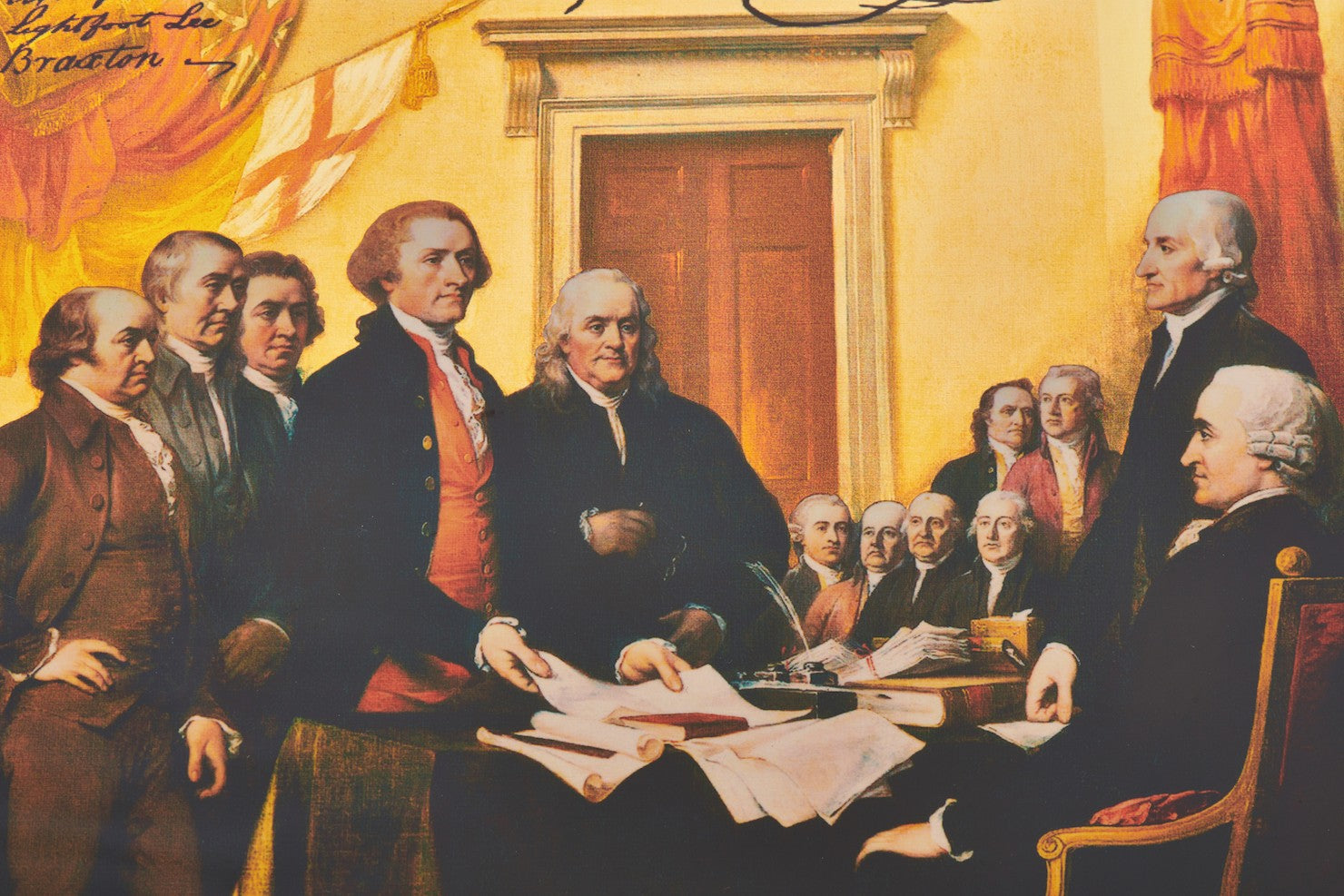
Perhaps the most well-known artist to document the American Revolution, John Trumbull created dozens of historical paintings over the course of his career. His most famous work, Declaration of Independence, was completed in 1817 and is one of four Trumbull paintings hanging in the United States Capitol rotunda. This painting depicts the five-man drafting committee as they present their draft of the Declaration of Independence to Congress in late June of 1776, mere days before the document was officially finalized and signed. A total of 42 of the 56 signers of the Declaration are depicted in this painting, with the remaining 14 men omitted due to Trumbull’s inability to find visual likenesses of the missing signers.
Trumbull is known to have taken some creative license with his depiction of this historic moment, not only because he was unable to find reference images for some of the signers, but also because there is an ongoing debate about which of the Founding Fathers were actually in the room when the draft was presented. Nonetheless, Trumbull’s Declaration of Independence remains a beloved artifact of American history, and is still one of the most recognizable depictions of the American Revolution. It has been reprinted on postage stamps and U.S. bank notes, as well as depicted in popular media such as HBO’s 2008 John Adams miniseries.

Second Continental Congress Declaration of Independence
As described in the previous section, John Trumbull’s painting of the Second Continental Congress receiving the draft of the Declaration of Independence is one of the most popular depictions. This oil painting includes 47 of the key figures who participated in drafting the Declaration of Independence during the summer of 1776, ultimately finalizing it at what is now Independence Hall in Philadelphia, Pennsylvania.
Since 1776, Independence Hall has served as a symbol of American democracy and freedom. The building remains standing to this day, and is now designated both a National Park overseen by the United States Park Service, as well as a UNESCO World Heritage Site. Independence Hall attracts more than 600,000 visitors each year, many of whom are drawn to the building after viewing John Trumbull’s painting.

A Lasting Celebration of American Freedom
Now is your chance to display your patriotism and honor the 250th anniversary of the United States. With our Celebrate Independence collection, you can choose your favorite poster in the series or collect all four. Whether you display these posters in your home or workplace, or gift them to loved ones, we are confident that you’ll love our Celebrate Independence collection.


Share:
Aurum Storage Size Guide
The Origin of the U.S. Dollar